You can browse Geoff's travel photos
with examples from Himeji, Hiroshima, Kyoto, Miyajima, Munich, Nara, Osaka, Salzburg, San Diego, Seoul, Tokyo, Toronto, etc.
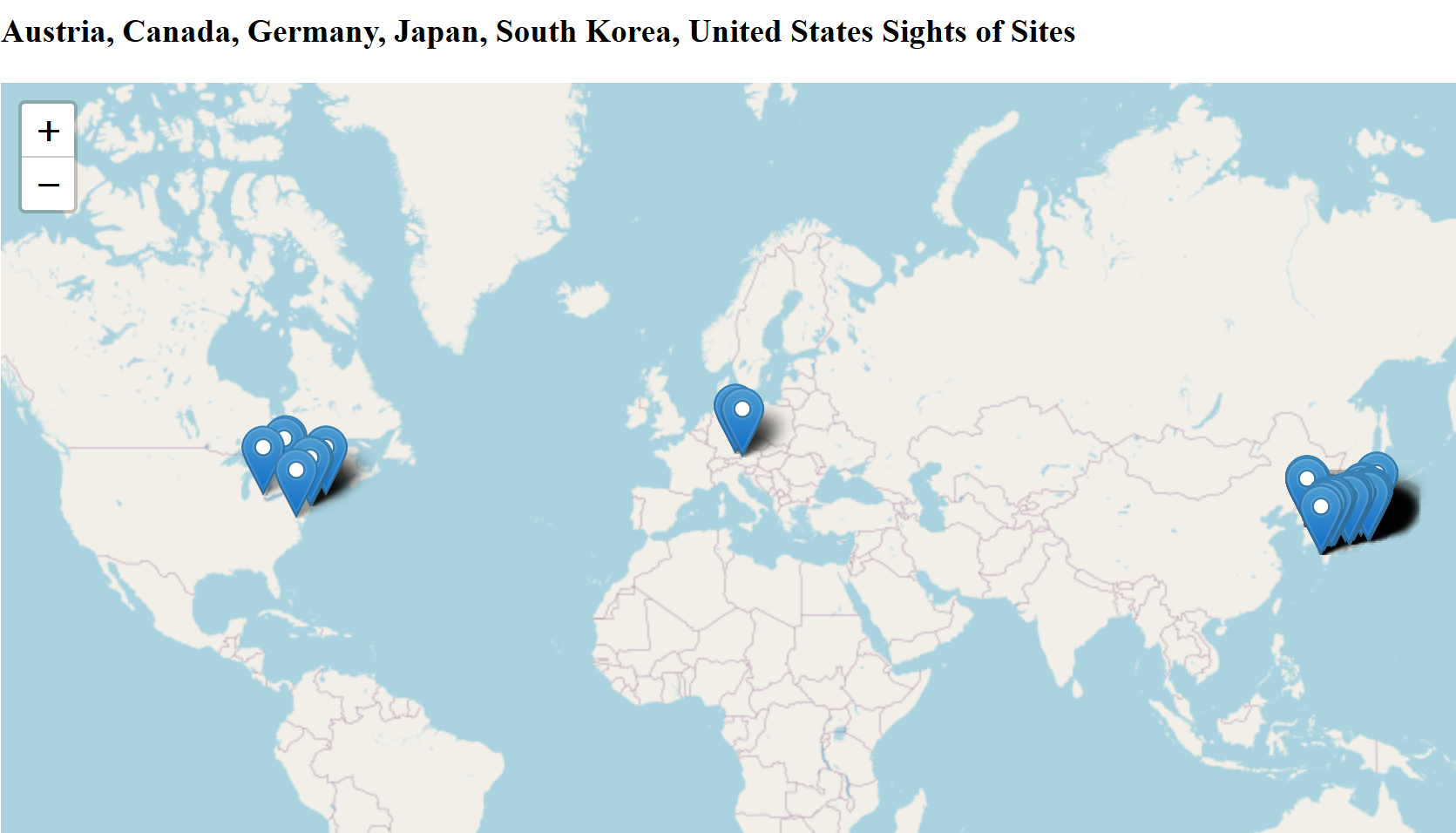
These are organized across a map of the globe and broken into sub-regions, each of which has a threaded chain of photos and
videos. The maps for each region indicate where the imagery were taken and each detail page also includes a close up map of
the area (unless the actual location was unknown, which should be rare for any content that was made available here).
How to Use the Maps
If you hover over a marker on the globe or region maps, a tool tip should appear with the title of the corresponding image.
Clicking on a marker will bring up a thumbnail of the associated image and the title of the image will serve as a hyperlink to
the corresponding detail page. Clicking on that hyperlink to reach the detail page will bring up a larger image of the
photograph, a more detailed (and possibly interesting) description as well as a high-resolution map of the area where
photograph was taken. The latitude and longitude are displayed at the very bottom of the detail page as an oft-overlooked
hypertext link to the corresponding location on Google Maps, which also makes it easy to use Street View if you are curious
about the site. The top of the globe, region maps and detail pages also contain a trivial menu allowing one to jump to the map
of a particular region. The detail pages also include (when appropriate) First, Prev,
Next, and Last links that allow one to navigate through the content. Some photos deemed of
sufficient quality are also exposed in a higher resolution than the normal downsampled size. When this situation is present, a
hypertext link announcing the availablility of a high-resolution photo (and its available resolution) is presented at the
bottom of the image; clicking on that link will load only the photo, which can then be zoomed in using most browsers.
Map Generation Tools
Tools to generate such galleries on your own are available for download. While
primarily intended for the display of photographs, video clips are also supported. Many of the images on display here
originally had dimensions of up to 6000x4000 pixels and would be approximately 25 megabytes apiece, but the entries in this
particular collection have all been resized to a maximum of 800 pixels in the largest dimension. That resize drastically
reduces the number of bytes required to be transferred to the point that they are between 40-80 times smaller than the
original, but sometimes this can result in a noticeable degradation of visual quality from the original. However, as noted
above, some of the more interesting images are also made available at full resolution and this will be noted on the
corresponding detail page.
GPS Data Acquisition
Since 2009, I have used some model of watch from Suunto
to track my routes. The X10 model had a hard time making it through an entire day of sightseeing and my most tragic loss of
tracking data was when the battery was exhausted while I was descending Mt. Misen. The battery life in the Ambit that replaced
it has been significantly better. Since 2015, I have augmented the Suunto-acquired data with tracks obtained via the app
gps4cam: cell phones have a larger battery capacity and are
far easier to recharge in the field. Unfortunately, gps4cam has a tendency to suspend itself, which can lead
to some deep sadness if you fail to discover the unintended outage until much later. In case it is not obvious, I will note
that one does not need to have retain services from the local cell phone carrier for the GPS tracks to be logged. For both
acquisition mechanisms, I find one needs to select the most frequent polling interval. One will invariably encounter outages,
perhaps due to stepping inside a building, having the sky obscured by a skyscraper or very leafy tree, etc. You will want to
recover from the error or outright outage as quickly as possible. Alternatively, you might be zooming along on a shinkansen,
which means you'll be covering a lot of ground every second. Slower polling rates yield better battery life, but also create
very coarse tracks that are both error-prone and have a low probability of having a data point logged at the time you pressed
your shutter button.
Eventually, all of the GPS track data gets applied to the set of photos using exiftool. In an ideal world, everything
will just work; however, some form of repair is almost always needed. I have had to write custom rules to correct the recorded
time zone formats generated by various cell phones and dedicated cameras from different vendors. For starters, the same set of
metadata is not recorded for each camera or cell phone. Worse, it is possible for fields that should have been consistent
within a single device, such as FileModifyDate, CreateDate, and ModifyDate,
to not be aligned. Some devices completely fail to record the time zone. Others fail to take into account daylight savings time
or the lack thereof in the foreign time zone. I have also had to handle idiosyncrasies such as a family member's cell phone
thinking it was still on Pacific Time for their initial set of overseas photos because their phone had not yet connected to the
foreign cell phone network.
Suggestion: when feasible, it is very helpful to get an image of a few clock displays to help sort out any
confusion when you return home.
As to the precision of the locations...it varies and brings with it the question as to what should the location marker
identify: the place where you were standing when the photograph was taken or the location of the object that was the subject of
the photo? The divergence between these two is most exacerbated when the photograph was taken using a telephoto lens. For most
of the photos shared here, the locations simply mark the spot from where the photograph was taken and the description of the
photograph often provides some hint as to the direction in which the camera was pointing.
Favorite Images
There are more than 300 images and videos on display here, which can make for a lot to traverse in one sitting. Many of the
images were recorded in the camera's raw format and have been post-processed to convert them to JPEG images. Two forms of
manipulation have been performed on occasion: an image may have been cropped to remove a person or distracting object and the
skies in some images have also benefited from the removal of spots created by dust on the lens. Thumbnails of my favorites are
listed below; clicking on an image will take you to directly to the corresponding detail page.
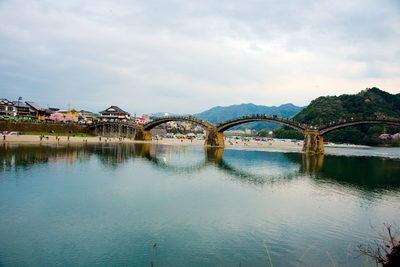
Kintai Bridge at Iwakuni in Yamaguchi Prefecture is an interesting pedestrian bridge with its multiple arcs. It has shown
up as a photo spot ("scape") in Gran Turismo Sport on the Playstation 4.
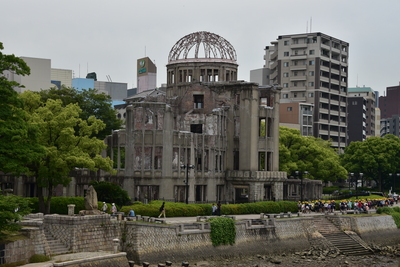
It is amazing how Hiroshima has recovered, but it is impossible to not reflect on what happened. The hypocenter memorial
in Nagasaki simply does not have the same impact.
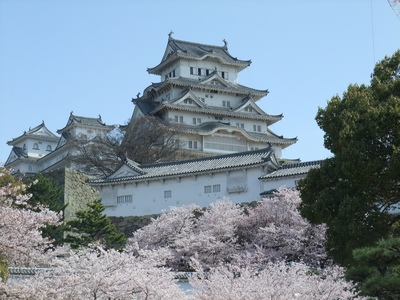
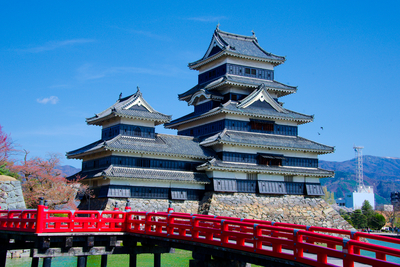
Perhaps the best preserved Japanese castle. In contrast to several of the other castles, much of the layout of the castle
grounds were also preserved so one can see how the hills, switchbacks on paths and overall layout contributed to its
defense.
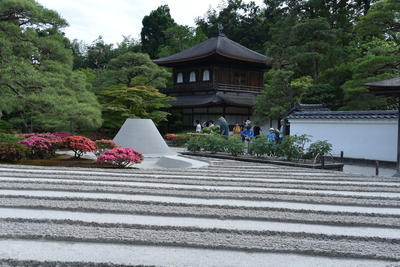
The effort expended on the sand garden at Ginkaku-ji in Kyōto has amazed me and given me pause while watching a rain storm
slowly dissolve the precision placement of all of those grains of sand. I would have sprayed the entire thing with a clear
epoxy to freeze it in place...but I recognize that would defeat the purpose. A "Secrets of the Ginkaku-ji Temple for
Sandcastle Builders" book could be a big revenue generator.
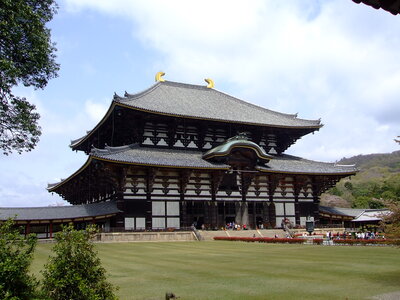
Despite having shrunk over the 12 centuries since it was first built, the size of the building and the great Buddha statue
contained within it are hard to comprehend and make it one of Nara's must-see sites.
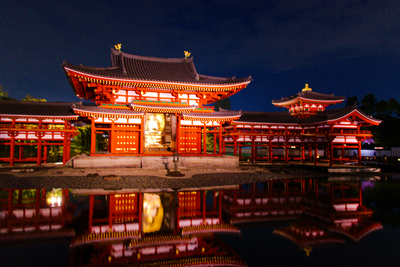
The hall is famous, since it is on the 10-yen coin, but this image during a special nighttime illumination was difficult
to obtain. This temple in Uji also has a notable museum in an ultra-modern building and should not be overlooked.
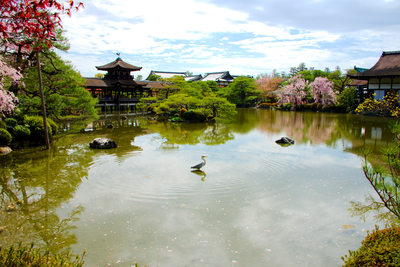
A favorite shrine of mine in cherry blossom season as the concentration of cherry blossom trees is hard to beat. Despite
being surrounded on 4 sides by streets, it manages to be an oasis of calm in Kyoto.
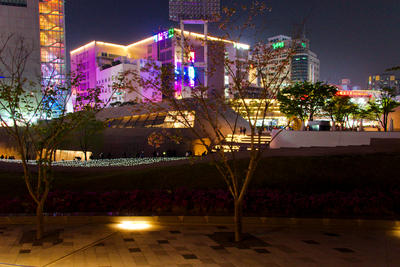
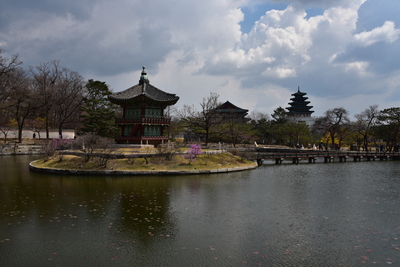
Alas, this is not the favorite spot on the pond perimeter for a photograph, but the crowds near the bridge across the pond
are too dense to isolate out of an image. As a consolation, one can see the pagoda rising out of the National Folk Museum of
Korea in the background.
Additional Site/Sight-specific Information
The following sections provide more details on the locations.
Kyōto
Probably my favorite city; a wonderful blend of the ancient with the ultramodern. The fact that it is about 15 minutes away
from Osaka via the Shinkansen can be startling when one is used to the relatively plodding pace of train service in the US
Northeast corridor.
Kinkaku-ji
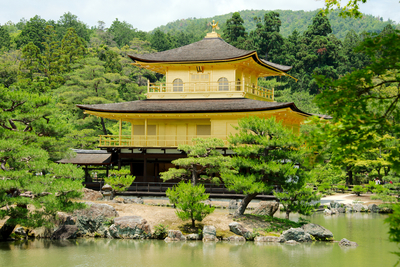
The Temple of the Golden Pavilion is probably the most well-known site in Kyōto. The
gold leaf exterior is stunning in the sunlight; its beauty is dimmed only by the realization that this is a modern feature
applied after the original building was destroyed by arson in 1950 and subsequently reconstructed in 1955. The remainder of
the temple grounds are OK, but I find them to be some of the least compelling amongst its peers. On the other hand, I did
observe a remarkable incident during a 2015 visit.
Ginkaku-ji
The Silver Pavilion is an interesting compliment to Kinkaku-ji. The sand tables are
amazing and the representation of Mt. Fuji is famous. The impermanence of human works is driven home by watching a rain
shower slowly dissolve the apparently flawless precision of the patterns that have been molded in the sand. If I had been
able to achieve such a good-looking result, I would have sprayed it with epoxy to lock everything in place...and thereby
demonstrate I had failed to understand a key part of the meaning. The grounds have a nice moss garden.
Philosopher's Path
While often referred to as the Philosopher's Walk, the alliteration of
Philosopher's Path is more appealing in English. In contrast to the engineered beauty and daily upkeep found in most temple
and shrine grounds, this canal-side path is just there and that is probably why it is one of the places I find most
interesting. When leaves are on the trees, it can be hard to see more than a block ahead due to the density of branches
reaching out over the canal. In cherry blossom season, one could be forgiven for thinking the clouds had descended to be
just over your head.
Heian-Jingu
While the oldest buildings are only a little over 115 years old, the intentional beauty of Heian-Jingu is breath-taking. The explosion of color in cherry blossom season almost defies description: the
northwest corner of the grounds contains so many trees that it appears that one is in a cathedral formed from blossom
branches. The remainder of the grounds have varied and compelling views oriented around a large pond. This was the first
Japanese shrine I visited and, like a baby animal, I might have imprinted upon it.
Ryōan-ji
The Ryōan-ji temple
is most famous for its dry rock garden and many people take the time to sit and ponder the view. The outer grounds include
a large pond with a walking path, moss gardens and a forest of pruned evergreens. Many of the features have been replicated
at the Brooklyn Botanic Garden.
Kiyomizu-dera
The Kiyomizu-dera
temple complex is a favorite of many and the origin of the phrase "to jump off the stage at Kiyomizu" (even referenced in
the Pandora's Box episode of Lucky Star when they visited the
site). The three streams of the Otowa waterfall are a popular draw and one will have to decide whether to be greedy and
drink from all 3 streams or be more selective. One of the best possible souvenirs is the 100-yen blessed water bowl; there
are special holders available for the bowls in addition to the normal ultraviolet light-sterilized metal cups-on-poles.
This complex should be visited both during the day, when everything is opened (such as the Jishu Shrine with its focus on
love and good matches), and at night, when the grounds are illuminated and the atmosphere is magical. If you are trying to
minimize costs, coming around dusk might be best.
Nanzen-ji
The Sanmon at Nanzen-ji is famous for its association with the execution of Ishikawa Goemon by boiling. If you pay an
admission fee, one can climb to the second story of the main gate and walk around the outside deck. I would recommend doing
this, as the opportunity to actually go inside a Sanmon is rare and the views from the outside deck have appeared in many
paintings. The Lake Biwa aqueduct also traverses the grounds and you can climb a short hill that enables you to walk over
the top of the aqueduct.
Sanjūsangen-dō
The extreme length of the main hall at Sanjusangen-do is used to hold 1000 statues
of the Thousand-Armed Kannon in 10 rows of 100 statues. One is not permitted to take pictures inside the hall, which no
doubt increases the must-see nature of the facility. That said...there are too many statues for a photograph to capture;
you really have to see it and slowly walk the length of the building to experience its impact. There are two spectacular,
but very small ponds (so small as to be quite viable in the corner of an average backyard) on the periphery of the grounds.
Archery contests have been held on the grounds since the 1600's; now they are held on the second Sunday of January. A
sample of roof rafters embedded with arrow shafts is on display and looks much like a wooden porcupine.
Ninna-ji
The Ninna-ji complex has several interesting buildings and is quite attractive. I used a photo of the Shinden's
north garden as a background on my checks. Ninna-ji is actually a very large complex and it takes some time to see the bulk
of what it has to offer, which helps ease the sting of the garden entrance fee. Incredibly, there is an awesome Ninna-ji
English language blog with a wealth of information and photographs; unfortunately, the hard-working Canadian who
populated it with content had to return home in 2013. Given that the temple has been around for hundreds of years, much of
the content will still be relevant as the years go by. While I have never been treated rudely at any shrine or temple, my
experiences with Ninna-ji are notable because the staff has seemed to practice active kindness. For example, while visiting
in a downpour, my party was offered the use of an umbrella when purchasing our entrance tickets. When we attempted to
return the umbrella after our visit, we were politely refused and enjoined to retain it as we continued our travels.
Maruyama Park
The Maruyama Park is between the grounds of the Yasaka Shrine and the Chion-in temple. The weeping cherry
tree that dominates the center of the park is famous, but the pond and stream are also attractive. When the place is filled
for cherry blossom viewing parties, the walkways are lined with vendor stalls selling food and offering some simple games.
I have not seen goldfish scooping (sorry Mikuru), but that might just be due to bad
timing.
Chion-in Temple
Just north of Maruyama Park, the large grounds of the Chion-in temple complex hold several secrets and
the main gate is the largest surviving Sanmon in Japan. It is best to be aware of those hidden features, like the
nightingale floor boards or the umbrella and rice paddle hidden in the rafters, before traversing this large site. Access
to the top of the complex is via a series of very long, very steep steps...
Yasaka Shrine
Alongside the western edge of Maruyama Park, the Yasaka Shrine is probably most famous for its
location and hosting the Gion Matsuri festival. It is small, old (dating back to the mid 600's), and probably more of a
place that sightseers pass through rather than a destination in itself. No admission fee.
Fushimi Inari Taisha
The Fushima Inari Taisha complex is huge, encompassing the side of a mountain. It is
probably most famous for the thousands of torii gates that line its pathways. One could easily spend the day wandering the
mountain paths.
Kamo River
The banks of the Kamo River hold walking paths that allow pedestrians an unobstructed view of the river. It is
probably about a 2-to-3 hour walk between the Kamigamo and Shimogamo shrines.
Kamigamo Shrine
Probably the most famous imagery of the Kamigamo Shrine is that of the two sand
mounds called Tatesuna and Saiden. No admission fee required.
Shimogamo Shrine
The sister of Kamigamo Shrine, Shimogamo Shrine is found to the south.
Archeological research has been undertaken at the site to unveil ancient artifacts. No admission fee required.
Hozu River
The Hozu River winds its way in an S-shaped loop alongside the west side of Kyōto, changing its name at the
Togetsukyō bridge in Arashiyama to the Katsura River. There is a boat ride across the road from Kameokoa Station that eventually drops you at Arashiyama. The valleys are deep enough that it is hard to get
at least 3 GPS satellites in view at a time.
Iwatayama Monkey Park
The Iwatayama Monkey Park is on top of Mount Arashiyama. One can feed the Japanese macaques
(snow monkeys), but in a role reversal, the humans are in the cage while the monkeys roam free outside.
Nonomiya Shrine
The Nonomiya Shrine is a small shrine mentioned in the Tale of Genji; it lies within the
bamboo forest in Arashiyama.
Kyōto Station
The Kyōto train station is a well-loved hangout. Lots of food and shopping is to be found in the
lower level and there is a very cool computer-controlled water fall (it operates like a dot-matrix printer). The building
had a prominent role in Gamera: Revenge of Iris (Konata reminded me).
Big. Really big. An ultramodern infrastructure ties together disparate neighborhoods that have unique styles.
Sensō-ji
The Senso-ji temple is popular due to its location in Asakusa at the end of Nakamise-dōri.
Kaminarimon
The Kaminarimon is commonly known as the Thunder Gate, a famous entrance gate located at the start of shopping
area on Nakamise-dori.
Hōzōmon
The Hozomon is the innermost entrance gate on Nakamise-dōri. The Treasure House gate has 2 large sandals
hung on the outside.
Asakusa Shrine
The Asakusa Shrine is a small Shinto shrine next to the Sensō-ji temple; it is often overlooked by
visitors to the Sensō-ji grounds.
Akihabara
The area of Akihabara Electric Town is a much-loved destination for the otaku crowd seeking more product and as a
place to find new computer-related components. Animate probably gets most of my business
(even if it is annoying to have to buy items on the floor where they were displayed) with the Tokyo Anime Center in the
UDX
building coming in second.
Harajuku
If you are interested in extreme fashion, head over to Harajuku and stroll down Takeshita Street. The ability of some of the store assistants to rapidly display and re-fold piles of shirts
must fill their girlfriends with a warm glow of happiness.
Odaiba
The area of Odaiba is famous for its beach, amusement park, Fuji TV, museums and shopping. Sadly, the service at one of
the restaurants in the Little Hong Kong section of Decks is among the worst in the world. For a change of pace, take the
Sumida River Line water bus from Asakusa down to
Hinode and take the Yurikamome line train over to Daiba station.
Shinjuku
The Shinjuku area lays claim to being the busiest train station in the world. The First Kitchen restaurant dominates the intersection near the train station and has nice views out the
windows on the upper level dining levels.
Shibuya
The famous loyalty of the dog Hachiko is remembered by a statue in front of the Shibuya station. The scramble crossing in front of the station is well-known for stopping traffic in all
directions and the incredible sea of people—standing room only indeed.
Tokyo Tower
Once the tallest artificial structure in Japan, Tokyo Tower was surpassed by the Tokyo Sky Tree in March of 2010; I managed to photograph the Sky Tree (and Tokyo Tower) six days after the
event. Nice views from the observation decks.
The Ginza district is known for being upscale and thus really expensive. The Godzilla statue is a few blocks
south of the Koban structure; it's merely people-sized.
Kabuki-za
The Kabuki-za theater was torn down a few days after I took a photo of it in April of 2010.
Tokyo Imperial Palace
One can observe the Imperial Palace, but the grounds
are not open to the casual visitor. The Imperial Garden Theater is
across the moat to the southeast; the window washers rappel down the side of the building with buckets affixed to their
belts.
Nara
Nara is an old city and has not been very oriented towards tourism, though some progress was being made for the 1300-year
celebration in 2011. Typically one takes the train in from Kyōto, visits for the day and then returns back to Kyōto.
Nara Park
Considered large due to its more than 500 hectares (more than 1200 acres), Nara Park is definitely ruled by the Sika
deer that roam its environs. One can buy a package of crackers to feed these animals...but beware, as they are devoid of
the manners one normally finds permeating Japanese society. If you have a cracker, you will be aggressively pursued and may
even have your legs bruised by being hit with antler nubs if the more pushy (pun intended) of the herd attempt to get your
attention. On the other hand, once the crackers in your hands are gone, their attention will be diverted almost immediately
to the next potential source of goodies.
Tōdai-ji
Despite having been reduced in size over the centuries, the main temple building at Todai-ji is the largest wooden building in the world and holds the largest statue of the Buddha Vairocana,
which is more than 49 feet tall (almost 15 meters). One of the supporting pillars has a hole which is supposed to be the
same size as one of the Daibutsu's nostrils...if one is able to squeeze through it, something good is supposed to happen.
Sources conflict as to what that will be: some say you will be blessed with enlightenment in your next life, some say you
will gain health in your current life. Adults that can pull it off typically go through on their side (that is how I did
it).
Nigatsu-dō
The Nigatsu-do temple is subcomplex of the larger Tōdai-ji complex. There are good views of Nara from the
top of the hill.
Hōryū-ji
The Horyu-ji temple complex contains one of the oldest wooden buildings in the world. The site also
maintains a climate-controlled museum in which numerous treasures are displayed. This is a reasonably large complex and
admission is broken into 3 distinct sections. If you push it, you can make it through in about an hour, but it is worth
spending more time. Free English-language tours are available and it is definitely worth accepting the offer as these staff
members are able to shine flashlights upon key points of the buildings and on some of the treasures in the museum, thus
illuminating (pun intended) your understanding of the artwork. For example, it is almost inevitable that one would miss the
remaining flecks of beetle wing casings that used to serve as the enamel on an item in a display case, but it is very easy
to see with a light catching the iridescent reflection.
Yakushi-ji
The Yakushi-ji complex is well-restored (e.g., the main hall was rebuilt in the 1970's); however, one of the
pagodas dates from the 8th century. My belief is that it is the west pagoda that is the old one, but a few online sources
claim it is the east pagoda.
Osaka
More of a New York City feel than Tokyo due to its smaller size, but made interesting by the numerous rivers and canals
which criss-cross the area, resulting in more than 800 bridges.
Dōtonbori
The Dotonbori is a major tourist destination in Osaka. Even if you have not the slightest interest in people
watching, it is hard not to be fascinated/horrified by the hordes of men that swarm women on the Ebisubashi. The
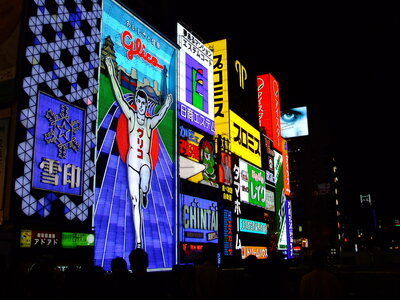
Tsutaya store invariably reduces the amount of currency in my wallet. The Glico running
man sign may be the most notable landmark of the area, but the animatronic crab of Kani Doraku is a close second.
Osaka Aquarium Kaiyukan
Like the Georgia Aquarium, the Osaka Aquarium Kaiyukan has whale sharks
on display. A very nice aquarium with a not-unexpected focus on regional waters.
Tempozan Ferris Wheel
It is impossible to miss the Tempozan Ferris wheel and the
Tempozan Harbor Village next to the Osaka aquarium; whether you partake of the experience is another question. The Tempozan
Harbor Village includes a store devoted to the works of Hayao Miyazaki (Kiki's Delivery Service and My
Neighbor Totoro are probably my favorites) and a "ninja" maze. The Ferris wheel's height of more than 360 feet yields
unobstructed views of Osaka's harbor region.
HEP Five
The shopping center of HEP Five also has a nice Ferris wheel which provides views of the center of the city. Shopping,
video games, motion simulator rides and good restaurants are present within this single complex.
Himeji
Between Osaka and Hiroshima lies Himeji, a modern city of more than 500,000.
Himeji Castle
While Himeji was bombed during World War II, Himeji Castle had the fortune to survive as
it has for more than 400 years. It is arguably the premier example of Japanese castles. A massive restoration effort began
in 2010, causing crowds to become almost unbearable as folks attempted to visit before the castle keep was covered up.
Quite a contrast to earlier visits. I lost count of how many elderly Grandmother-types just pushed their way in front of me
while working one's way to the top of the keep; I had never experienced such behavior before. This site always has visitors
due to the quality of the grounds, but something flipped the manners bit off some of the people visiting in 2010.
Hiroshima
Hiroshima Peace Memorial Park
The Hiroshima Peace Memorial
Park is arguably the most important site in Hiroshima as it is devoted the memory of the atomic bombing of Hiroshima on
August 6, 1945.
Children's Peace Monument
The Children's Peace Monument is
surrounded by display cases filled with paper cranes made by people from across the world who continue to keep the memory
of Sadako Sasaki alive.
Hiroshima Peace Memorial
The most recognizable symbol of Hiroshima is probably the A-Bome Dome, the ruins of the
Hiroshima Prefectural Industrial Promotion Hall.
Hiroshima Peace Memorial Museum
The Hiroshima Peace Memorial
Museum is devoted to explaining the atomic bombing of Hiroshima. Free WiFi access if you register your email address.
Miyajima
Itsukushima Shrine
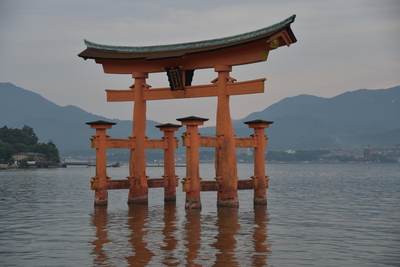
The torii at Itsukushima Shrine is one of the most famous images of Japan. The rice spoons of the
shrine are well-respected. The character of the shrine varies depending on the tide as the buildings are on piers. Low tide
drains the sea out past the torii itself, which enables visitors to walk up to it. High tide causes the shrine itself to be
surrounded by water.
Momijidani Park
The Momijidani Park is famous for its maple trees. Makes for an interesting walk/hike as one
approaches the base of Mount Misen.
Mount Misen
The slopes of Mount Misen on Itsukushima hold several temple buildings and shrines scattered
throughout the heights. Mount Misen also has good views of the Seto Inland Sea; one can see Hiroshima from the summit. I
inadvertently, albeit successfully, tested the abrasion-resistance of my Mountain Hardware jacket when I fell during the descent.
Daishō-in
One of the extraordinary features of the Daisho-in complex on Mount Misen is the temple of
the eternal flame, which has been burning since its foundation over 1200 years ago. I would not like to be the person who
forgot to restock the wood last night and let it go out after it had been burning for more than 438000 days straight.
Kobe
Kobe is a port city that celebrates its international ties, is modern while honoring its history, compact while seeming to
have everything you could ask for. I feel that if you asked someone to create a model of a city that had everything, you would
end up with something like Kobe.
Kobe Port Tower
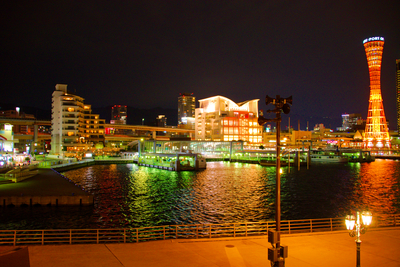
The Kobe Port Tower is a landmark appears in many movies and
television shows as a visual identifier for Kobe. It is very colorful at night and surprisingly small in diameter. The
Meriken Park area includes the memorial for the Great Hanshin Earthquake of 1995. During the morning of my very first
visit, I noticed a roped off section with a large object covered by a white sheet. During the evening news that night, I
saw that they had held a ceremony a few hours later to unveil the "BE KOBE" sign.
Harborland
The Harborland district near the Kobe Port Tower has quite a variety of stores.
The Mosaic mall, in particular, is graced by both an M78 and Rilakkuma store.
Yokohama
Yokohama shares some similarities with Kobe since both are port cities that have extensive international trade. Unlike Kobe,
Yokohama is only about 30 minutes away from Tokyo, so one could enjoy the less-crowded environment of Yokohama while still
having ready access to everything Tokyo has to offer.
Minato Mirai 21
The Minato Mirai area is where I have spent most of my time in
Yokohama. For the past several years, it has been host to Pikachu and Eevee outbreaks in August. There is a lot to see
here, from the Cosmo World amusement park, the Red Brick wharehouses, the Yokohama Landmark Tower, Ōsanbashi Pier, the
World Porters mall, and nearby China town.
Seoul
I have spent most of my time in Seoul north of the Han river, which can give rise to the illusion that Seoul is of
comprehensible size. That illusion will be dispelled if one can get high enough and look south as, like Tokyo, Seoul has
expanded to the horizon.
Deoksugung Palace
Deoksugung Palace was the first of Seoul's five grand palaces that I
visited. It is unique amongst the other palaces due to the presence of some modern Western-style buildings and gardens. The
National Palace Museum of Korea was still on the grounds during my first visit in 2001 and it was a very educational
experience for me. The museum has since relocated to Gyeongbokgung Palace.
Gyeongbokgung Palace
Gyeongbokgung Palace is the largest of Seoul's five grand palaces and is
commonly argued to be the most beautiful. It certainly has some photogenic water features. The National Folk Museum of
Korea is accessible from the northeast corner of grounds.
Changdeokgung Palace
Changdeokgung Palace is another of Seoul's five grand palaces. One of the
highlights is the "Secret Garden", which can be visited if one signs up for a guided tour (this currently costs 5000
won/person, and should be reserved online a few days ahead of time to ensure a slot). While one's experience will be
influenced by the quality of the guide, I was very impressed with the enthusiasm, knowledge and clarity of the
English-speaking guide on my tour. One could not have asked for a better, more professional presentation. Tours are offered
in several languages other than English.
N Seoul Tower
The N Seoul Tower is a great vantage point for seeing the breadth of the
city. Fans of K-dramas will note that the site makes a frequent appearance in many romance-related shows, with special
attention often paid to the locks chained to the fences. I have walked all the way up on foot, but most people will want to
take the cable car. I do think some form of Subway sandwich shop probably holds the record for most frequent appearances in
a K-drama, though.
Dongdaemun Design Plaza
The Dongdaemun Design Plaza is another striking work by the late Zaha Hadid. The
building itself serves as a cultural center, so the some of the content changes depending on what event is being hosted.
Some of the shops offer very unique works, but the exclusivity and uniqueness can carry a nontrivial price tag.
Lotte World Tower
The Lotte World Tower is an impressive structure with 123
stories, but I have not been convinced it is worth the 27000 won/person for the trip to the Seoul Sky observatory
(sometimes discounts are available that can reduce the price to 17000 won). While the height can make for a rare
experience, one has to take into account the air quality and weather as they will have a great effect on visibility.
Arguably more interesting is the Lotte World Mall at the base of the tower.
Olympic Park
Unlike some cities that let their Olympic infrastructure decay into modern ruins, Seoul turned the area used for the 1988
Summer Olympics into the huge Olympic Park. The area near
the Peace Gate on the southwest corner of the park does the most to memorialize the actual 1988 Olympics and it is
interesting to see the flags on display as some represent countries that no longer exist...and there are a few amusing
spelling errors ("Great Bretain" stands out in my memory). Venues used for the Olympic are present on the east side of the
park and the KSPO DOME will be recognizable to many K-pop fans as a popular concert venue.
Munich
Marienplatz
The Marienplatz is the center of Munich. Dating back to the 1100's, it has not changed much in the past two
decades. The most prominent building is the Neus Rathaus, whose Glockenspiel clock is a major attraction.
Nymphenberg Palace
The grounds of Nymphenberg Palace are huge and
beautiful, but only a tiny fraction of the main palace complex is open for viewing (the main building). A very nice place
to visit for free walks on the grounds, but it is easy to be disappointed by the very limited amount of rooms and
furnishings on display for those who pay the admission fee.
Münchner Residenz
The Munich Residenz is a stark contrast to Nymphenberg Palace: pressed upon by the city on all
sides, it is the rooms and treasures on display that take one's breath away, not the outside gardens. The Residenz is huge
with over 100 rooms on display. For a separate admission fee, one can visit the Treasury and view a mind-boggling array of
treasure from all parts of the world. The statue of Saint George is spectacular, leaving no doubt as to why it was chosen
as the symbol of the Treasury. If one does not devote at least half-a-day to this amazing palace, you are cheating
yourself.
Frauenkirche
The twin towers of the Munich Frauenkirche are visible
throughout much of Munich and are a well-known landmark. From the location of the Devil's Footstep, one cannot view any
windows.
The Deutsches Museum is one of the best museums in the world devoted to science and technology.
Unfortunately, the sheer extensiveness of the collection and the constrained real-estate imposed by being located on an
island in the middle of the Isar river has required that key segments of the collection be relocated to distinct sites.
That is a net loss, unless one is able to make the effort to seek out and visit those alternate sites.
Königsplatz
The K�nigsplatz area is now surrounded by art museums and is known for its Greek-style buildings
and usage during World War II.
Alte Hof
The Alte Hof is an old palace probably best known for the tall tale of the monkey having kidnapped the baby king
Ludwig and carried him up into the windows of the Monkey Tower. Of course, it would help if the windows actually existed
back then...
Dachau
Konzentrationslager Dachau
The Dachau Concentration Camp is a
different experience now than it was two decades ago ( it was redone in 2003). The normal entrance is now from the west
through the gate with the infamous "Arbeit Macht Frei" phrase. There is arguably more information presented, but they may
have unintentionally made the experience more clinical. If you visit, I recommend absorbing the atmosphere and buy the
museum's book which contains details on everything presented.
Salzburg
A favorite of most who have been fortunate enough to visit, Salzburg is a small, beautiful historical town made world-famous
by serving as the backdrop of The Sound of Music. Undoubtedly worth at least a day trip, it is small enough that most
folks will feel they had walked through the entire place within 3 days.
Mirabell Palace
While not huge, Mirabell Palace has a very beautiful arrangement of flower beds. The fountain and steps
appeared in the The Sound of Music.
Hohensalzburg Castle
High upon a mountain in the middle of the valley lies Hohensalzburg Castle, an incredible
engineering feat. You can take a long, steep walk or ascend via a 2-rail funicular. There is a museum
devoted to marionettes, which is often found to be a bit creepy and is easy to avoid visiting.
Residenzplatz
The largest baroque fountain in Europe lies in the Residenzplatz and one can pay for a
horse-drawn carriage ride through the city; both were featured in The Sound of Music.
Toronto
Toronto is usually quite clean, even when the sanitation workers are strike, but little sticks out as being notable amongst
the world's cities. The CN Tower is now merely the tallest free-standing structure in the Western Hemisphere...but it is still
quite tall.
Ontario Science Centre
Surprisingly, the Ontario Science Centre is much as
it was when it opened in the early 1970's. One could argue that is because elementary physics itself has not changed. The
once-impressive time-sharing computers with the glass TTY terminals are long-gone, though, as they would be relics compared
to even the cell phones people carry today.
Casa Loma
The height of Niagara Falls made them attractive for hydroelectric power generation and Sir Henry Pellat built Casa
Loma, the largest private residence built in Canada, using the fortune he was making bringing electricity to Toronto.
When the government took away his businesses, he lost it all.